


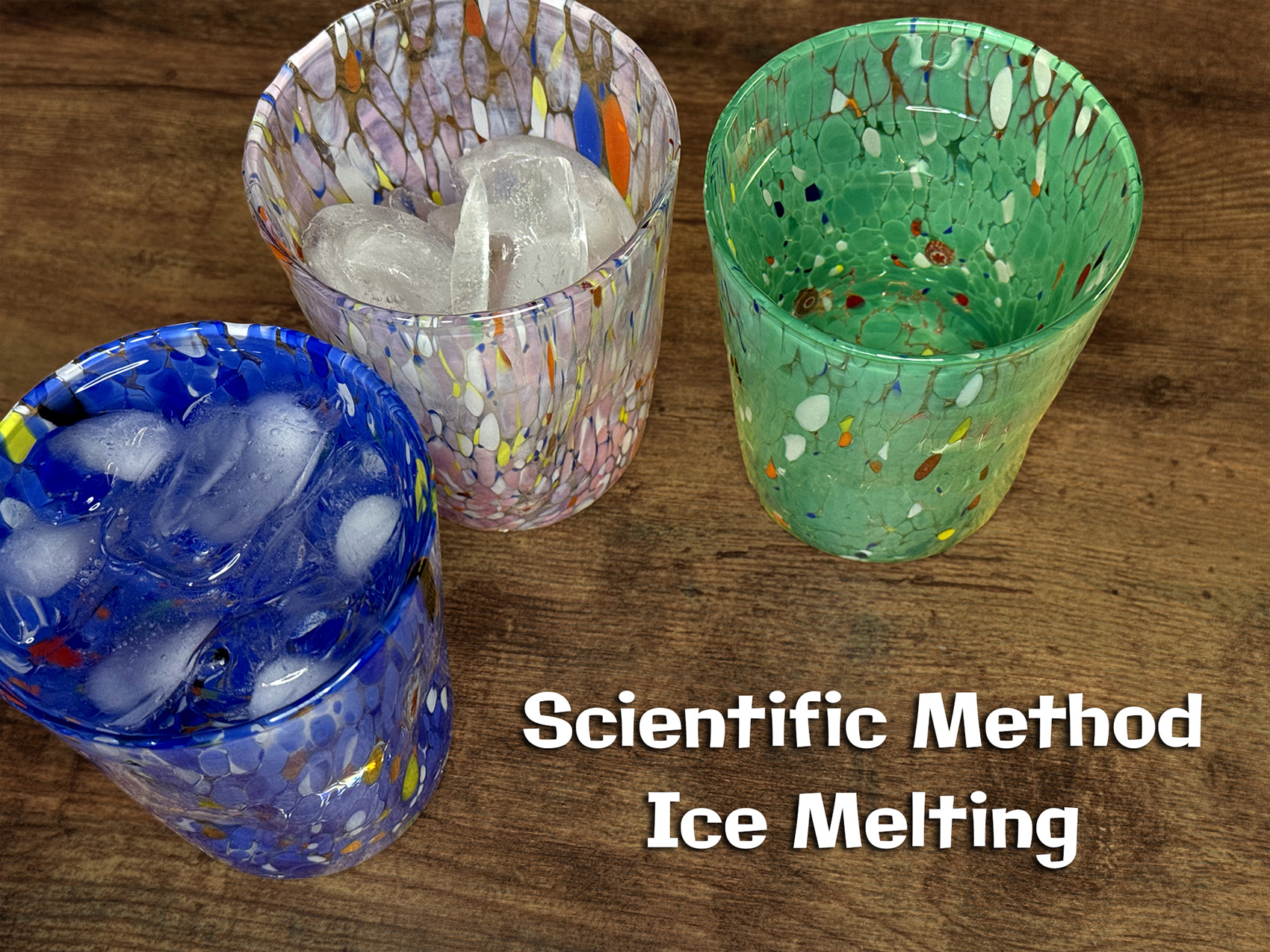
By February, we’re all eagerly awaiting the arrival of spring. But it’s still the perfect time to do a chilly experiment that introduces or reinforces the basics of the scientific method alongside essential math skills. Read on for two simple ice cube activities you can do that are suited for different ages!
Melting, Comparing Time, and Elapsed Time
No age is too young to introduce the scientific method! With just a few items and a little bit of time, you can easily give young kids their first taste of it.
What you’ll need:
at least 3 ice cubes
1 or 3 cups
three temperatures of water: hot, cold, and room temperature
a timer
a clock (optional)
scratch paper
Step 1 - Introduce the Scientific Method
Talk with your child about how science uses repeatable tests and observations to answer questions. The question you’re answering today is: Does temperature change how quickly ice melts?
Explain that a hypothesis is a kind of prediction—and it’s time to make yours! Will an ice cube melt more quickly in cold water, room temperature water, or hot water? Once a scientist has a hypothesis, they must come up with a way to test it to confirm the real answer. That’s what we call an experiment!
Step 2 - Perform Your Experiment
You’ll need a little prep work for this experiment. Leave a glass of water out ahead of time to be sure it’s room temperature. If you have very cold tap water, that’ll work for the cold test. If not, make sure to keep some water in the fridge overnight. Treat hot water similarly: hot water from the tap is fine, but if that doesn’t get very warm, be ready to heat some up with a microwave or stove. Make sure it’s still safe to handle.

To test how quickly ice melts at room temperature, place an ice cube in the cup with room temperature water. Set a timer and keep it going until all the ice melts away. If you plan to review elapsed time, also note the times you added the ice cube and when it fully melted.

Repeat this with the cup of cold water and the cup of hot water. Depending on how patient or attentive your child is, you can test all three conditions at once or one at a time.

Step 3 - Review Results and Time Skills
Compare the results you recorded. Was your hypothesis correct? How much longer did it take certain temperatures to melt than others? Practice subtracting times to find the answers. Is it more than expected? Less?

Cooling, Temperature, and Rate
This experiment is a little more involved and uses more advanced skills.
What you’ll need:
at least 6 ice cubes
at least 3 glasses of room temperature water
a timer or clock
a thermometer (digital preferred for accuracy)
scratch paper
graph paper (optional)
Step 1 - Review the Scientific Method
As with the simpler experiment, start by reviewing the basics of the scientific method and making your hypothesis. You’ll be addressing a different question: How does the amount of ice impact the rate at which water cools?
Step 2 - Perform Your Experiment
Set up a glass of room temperature water. Use a thermometer to confirm and record the exact temperature. Place one ice cube in it, then start a timer. Check and record the temperature of the water at a consistent yet engaging interval, such as every 30 seconds, 1 minute, or 2 minutes. Continue until the ice melts.

Repeat the process on a second cup that contains two ice cubes, then a third cup that contains three ice cubes. Feel free to do the experiment with double the number of ice cubes to prompt more obvious and rapid changes in your data. You may also choose to include a fourth glass with no ice to explore the role of control groups.
Step 3 - Review Results and Math Skills
A quick glance at your data table might give you a general sense of how much more quickly different amounts of ice can cool water. However, it won’t give you the exact rates. It’s time for some math!
Review rate as a ratio comparing one thing to something else. In this case, it’s temperature change (degrees) to time (minutes). Calculate the difference between the starting temperature and the end temperature, then divide by the total number of minutes you ran your experiment. Remember: 30 seconds represent 0.5 minutes. Once you have your single-number rates, you can compare to confirm or disprove your hypothesis once and for all.

This is also a good chance to practice line graphing. If you don’t have dedicated graph paper, a template like this one is fine. Simply use temperature as the y-axis and your time increments as the x-axis, then plot and connect your data points in different colors. It’s a fun, quick way to visualize your data!